At Make Sense, we sat down with Yuri Rodionov, Social Media and Creative Head formerly at Universal Music, Sber Ecosystem, and Vertex CGI, to talk about 2026 social media trends, how they work, who the audience is, and how to approach SMM.
A significant share of strategy and creative effort keeps shifting to social media. Once, socials were primarily the key channel for small and medium businesses, while for big brands they were just a side communication channel. Today, ignoring them is becoming a real problem.
The channel separation trend of the last few years — driven by the growing influence of algorithmic feeds and the increasingly visible differences between platform algorithms — has essentially led the industry to a point where every channel is fully autonomous. In any reasonable company, cross-posting and mere adaptation have been dead for over three years, but now this has become the norm for everyone. What’s more, social media teams themselves are taking on completely different structures: instead of SMM generalists, we now see narrow specialists and agencies that focus on content for one specific platform. And I’m not talking about “Reels girls” who learned from other “Reels girls” — no shade to all the girls out there. Essentially, this channel separation is what mainly drives the need for strategy and creative that connect these channels and make them effective from both a business and brand perspective.
There is still a huge amount of noise around AI, and I can’t ignore it, especially since I’ve spent the last year and a half working exclusively on creative and production with AI and VFX for major international brands. In short, I think the market is finally starting to sober up and move away from the tsunami of hype-peddler noise. No reasonable person still believes in content factories that produce 1,000 pieces of content a month by one person for $1,500. At the same time, audiences have learned to recognize AI slop, and most people now understand that AI is just a tool, something all competent professionals said from the start, but nobody listened in the rush to cut costs.
On the bright side, AI has made it very clear that concept often trumps execution: if you can create truly strong concepts, it will give you unlimited possibilities in the coming years. That includes trending AI series, viral videos, and even full-scale tests of business concepts without launching the actual businesses. And I’m not talking about vibe coders burning tokens at night, I mean physical-world projects like a coffee shop.
To sum up, I’d agree that AI right now is either about speed (for reactive content or super-fast production), or about concepting, or about quality. But it’s definitely not about cheapness, versatility, and that mythical SMM lead who will produce 1,000 pieces of content an hour and whom everyone is trying to hire on job boards.
Among the trends I’m watching closely myself, here are a few:
1. Social-First Campaigns
This trend has been building for several years and started with the bravest brands; now it seems to have become an absolute must-have for any decent brand. This year’s Cannes Lions shortlist confirms it once again: I highly recommend checking out the work from Coca-Cola, KitKat, Heineken, etc.
The core of the trend is simple: it’s not about adapting TV ads, it’s about full-fledged campaigns built specifically for each social platform, its audience, and its interaction mechanics.
Among the brands building their strategy around this principle, I’d highlight the following:
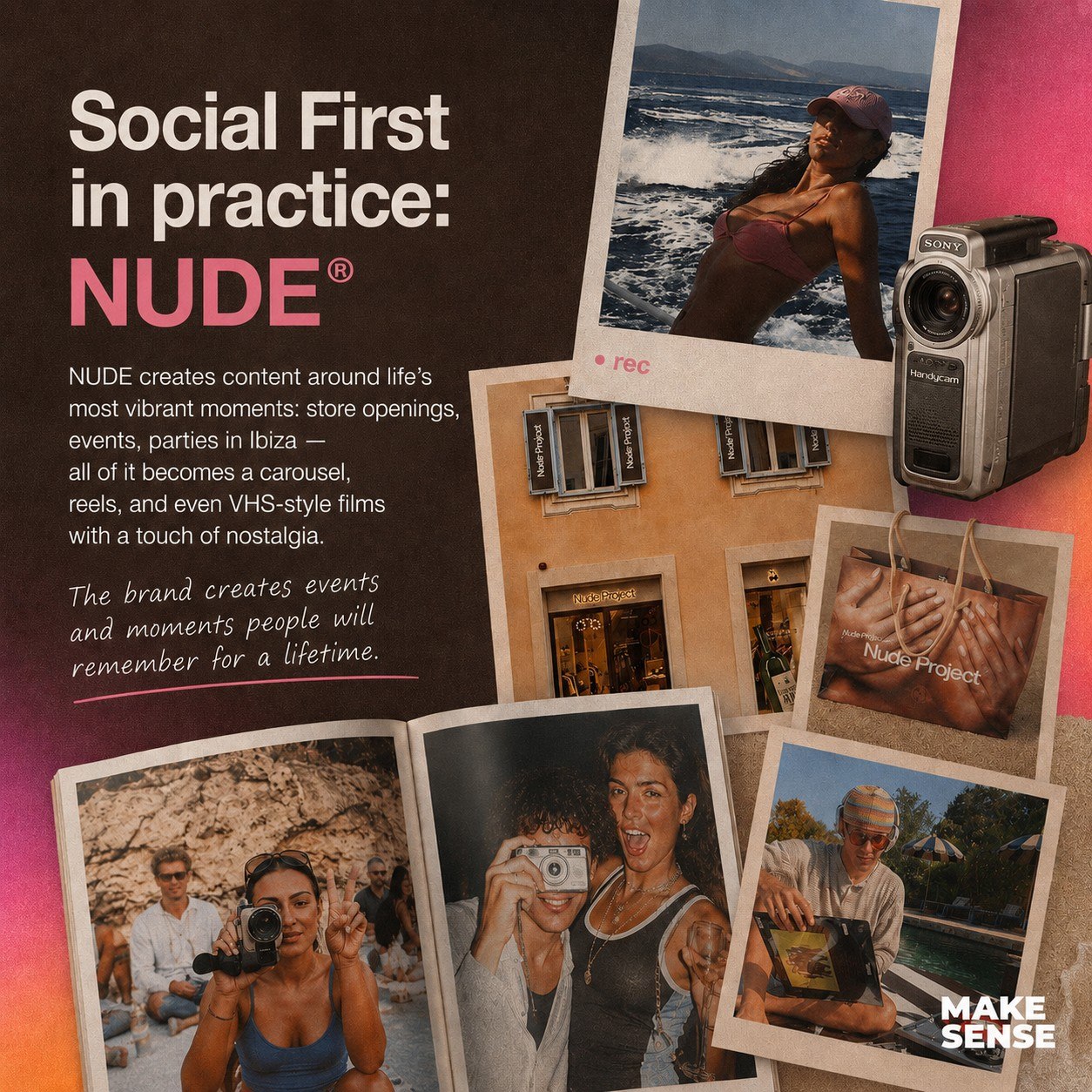
NUDE — these guys mix brand events, store openings, Ibiza parties, and social-first content, from party carousels to full VHS-style films (hello, nostalgia trend). They didn’t just hand a social media manager a phone and tell them to shoot Reels about themselves without leaving the office, pretending to show the company’s active life and employees who are never actually in the frame. They live with the record button constantly on — and in a way that millions of people watch. It’s not a reality show or a series; it’s a continuous wave of loud news hooks where the brand isn’t product placement but the very reason the event or story exists.
A significant share of strategy and creative effort keeps shifting to social media. Once, socials were primarily the key channel for small and medium businesses, while for big brands they were just a side communication channel. Today, ignoring them is becoming a real problem.
The channel separation trend of the last few years — driven by the growing influence of algorithmic feeds and the increasingly visible differences between platform algorithms — has essentially led the industry to a point where every channel is fully autonomous. In any reasonable company, cross-posting and mere adaptation have been dead for over three years, but now this has become the norm for everyone. What’s more, social media teams themselves are taking on completely different structures: instead of SMM generalists, we now see narrow specialists and agencies that focus on content for one specific platform. And I’m not talking about “Reels girls” who learned from other “Reels girls” — no shade to all the girls out there. Essentially, this channel separation is what mainly drives the need for strategy and creative that connect these channels and make them effective from both a business and brand perspective.
There is still a huge amount of noise around AI, and I can’t ignore it, especially since I’ve spent the last year and a half working exclusively on creative and production with AI and VFX for major international brands. In short, I think the market is finally starting to sober up and move away from the tsunami of hype-peddler noise. No reasonable person still believes in content factories that produce 1,000 pieces of content a month by one person for $1,500. At the same time, audiences have learned to recognize AI slop, and most people now understand that AI is just a tool, something all competent professionals said from the start, but nobody listened in the rush to cut costs.
On the bright side, AI has made it very clear that concept often trumps execution: if you can create truly strong concepts, it will give you unlimited possibilities in the coming years. That includes trending AI series, viral videos, and even full-scale tests of business concepts without launching the actual businesses. And I’m not talking about vibe coders burning tokens at night, I mean physical-world projects like a coffee shop.
To sum up, I’d agree that AI right now is either about speed (for reactive content or super-fast production), or about concepting, or about quality. But it’s definitely not about cheapness, versatility, and that mythical SMM lead who will produce 1,000 pieces of content an hour and whom everyone is trying to hire on job boards.
Among the trends I’m watching closely myself, here are a few:
1. Social-First Campaigns
This trend has been building for several years and started with the bravest brands; now it seems to have become an absolute must-have for any decent brand. This year’s Cannes Lions shortlist confirms it once again: I highly recommend checking out the work from Coca-Cola, KitKat, Heineken, etc.
The core of the trend is simple: it’s not about adapting TV ads, it’s about full-fledged campaigns built specifically for each social platform, its audience, and its interaction mechanics.
Among the brands building their strategy around this principle, I’d highlight the following:
NUDE — these guys mix brand events, store openings, Ibiza parties, and social-first content, from party carousels to full VHS-style films (hello, nostalgia trend). They didn’t just hand a social media manager a phone and tell them to shoot Reels about themselves without leaving the office, pretending to show the company’s active life and employees who are never actually in the frame. They live with the record button constantly on — and in a way that millions of people watch. It’s not a reality show or a series; it’s a continuous wave of loud news hooks where the brand isn’t product placement but the very reason the event or story exists.
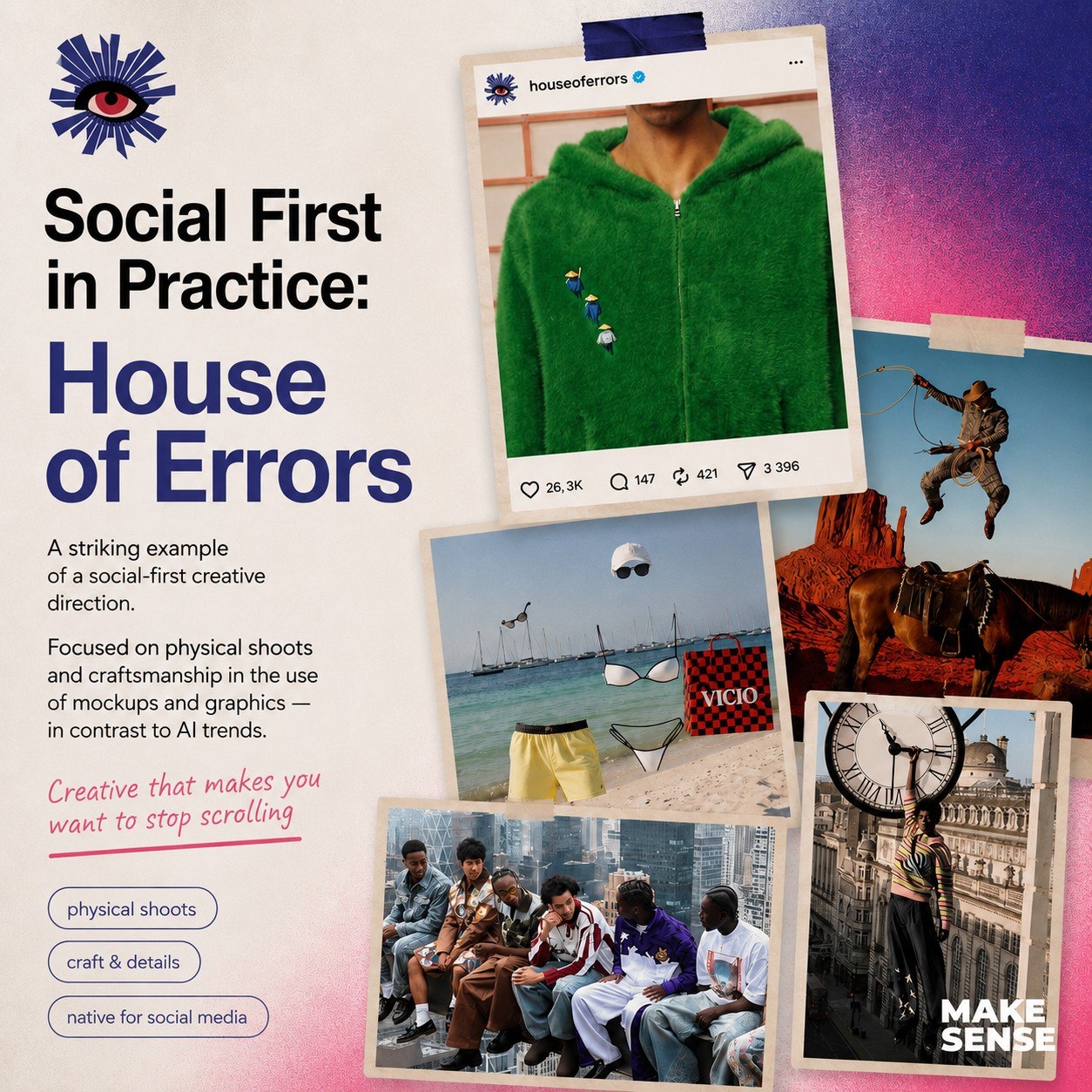
House of Errors and Late Checkout are great examples of social-first creative direction. It’s worth noting their focus on physical shoots and craft, using motion and graphics as a counterbalance to AI trends.
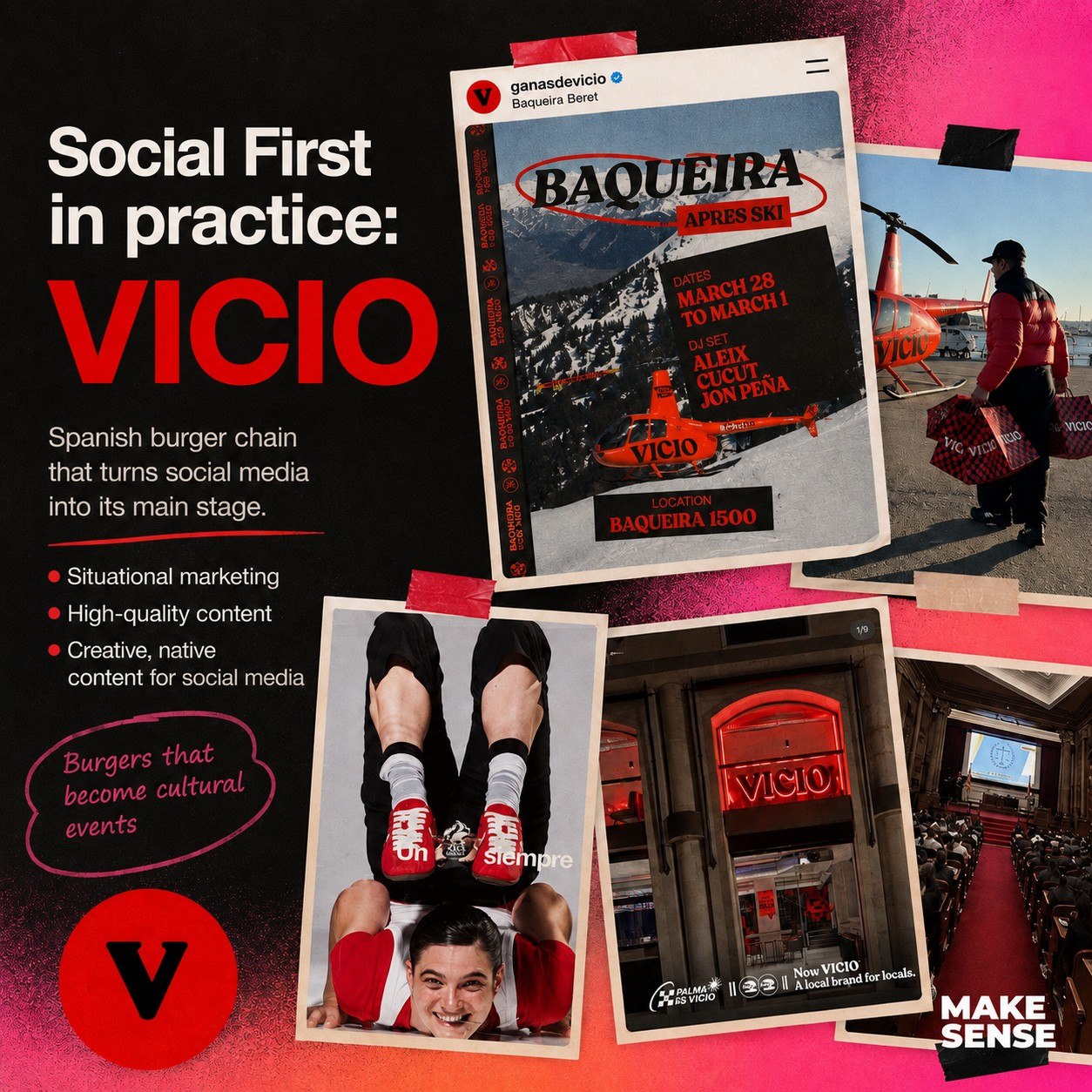
VICIO — another Spanish favorite of mine, with an insane level of creativity for a burger chain. They make truly stunning use of real-time marketing and visual creative that feels native to social media. Just look at the campaigns inspired by the Menendez brothers trial or burger delivery by branded helicopter to popular Spanish ski resorts.
Personally, I get a special kind of pleasure from following the campaigns by Yulia Shadrinski’s team: an endless source of creativity in a wild UGC-crime aesthetic. It has everything — from store robberies and exploding cars to a mock trial to showcase a new eyewear collection.
2. Reality Proof
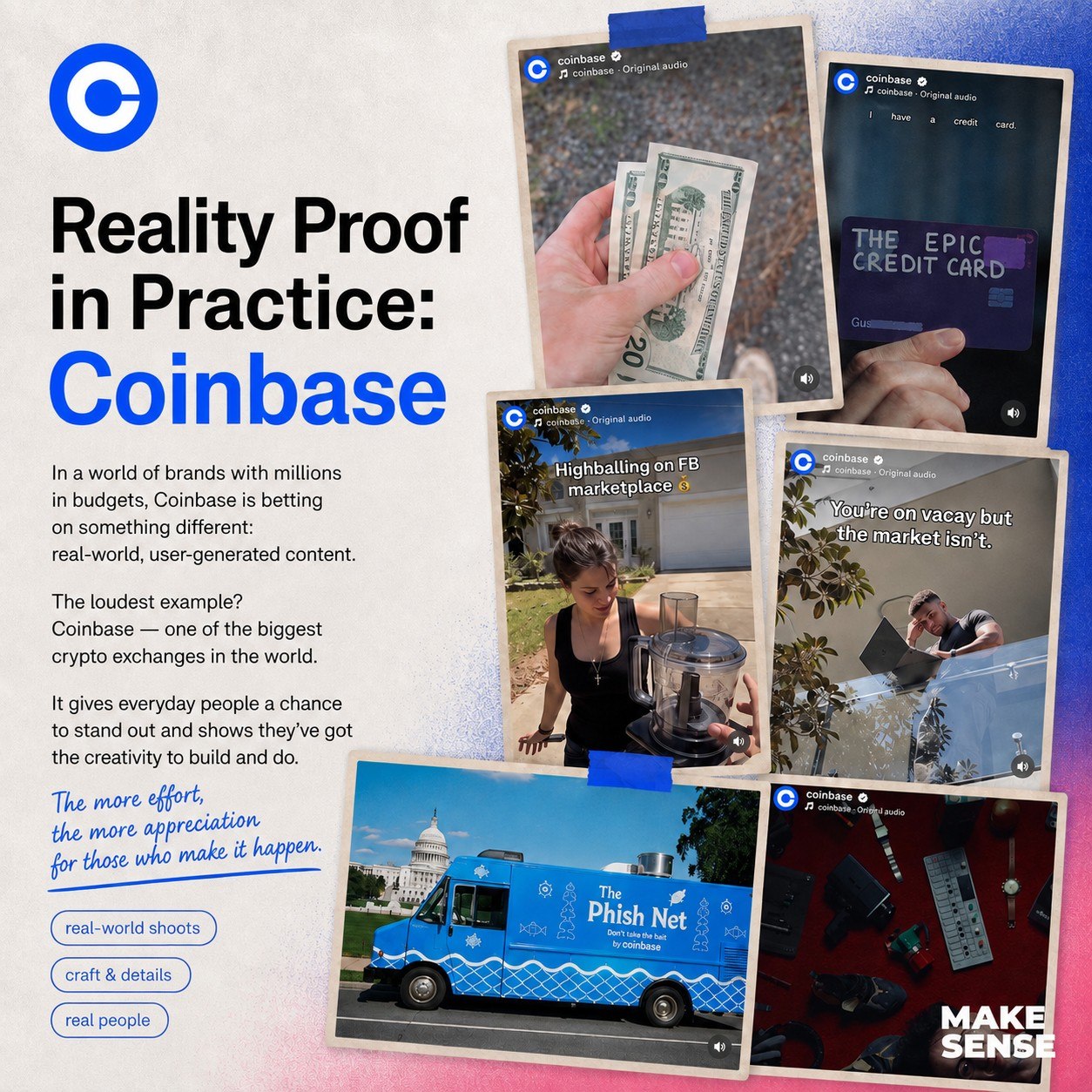
Only fish haven’t made a Reel about this, but it’s hard to deny the trend. As a counterweight to AI slop, brands with real budgets have started focusing on physical content production. Probably the loudest example here is the Coinbase case. In practice, this gives a chance to stand out not only to brands with money, but also to talented creators. The more slop there is, the more respect goes to those who make things by hand.
Along the same lines, UGC content is actively growing as a way to create a sense of realistic, raw footage, along with large rosters of UGC creators as a way to be TikTok-native. This trend applies to both big brands and celebrities who post unedited photos that look like they were shot on an iPhone 4, share unfiltered behind-the-scenes moments, and show their daily routine. I wouldn’t call it a “new sincerity,” but the stylistic trend is obvious: either join it or make work so good that you’re allowed to go against it.
For me, the peak was a case from an agency I worked with: after releasing the main viral video with CGI, they published a making-of breaking down the graphics process, and the audience exploded with joy that it was computer graphics, not AI. Yes, that happens.
For those who are afraid of such experiments, or whose brand director conservatively forces everything to be polished and every edge smoothed, the approach of creating additional channels has found new life. Apple, Netflix, KFC, Gucci, etc. already actively use this by creating separate accounts for UGC, niche areas, and absolutely wild experiments. This way they stay bold without taking on extra brand risk.
3. Collaborations
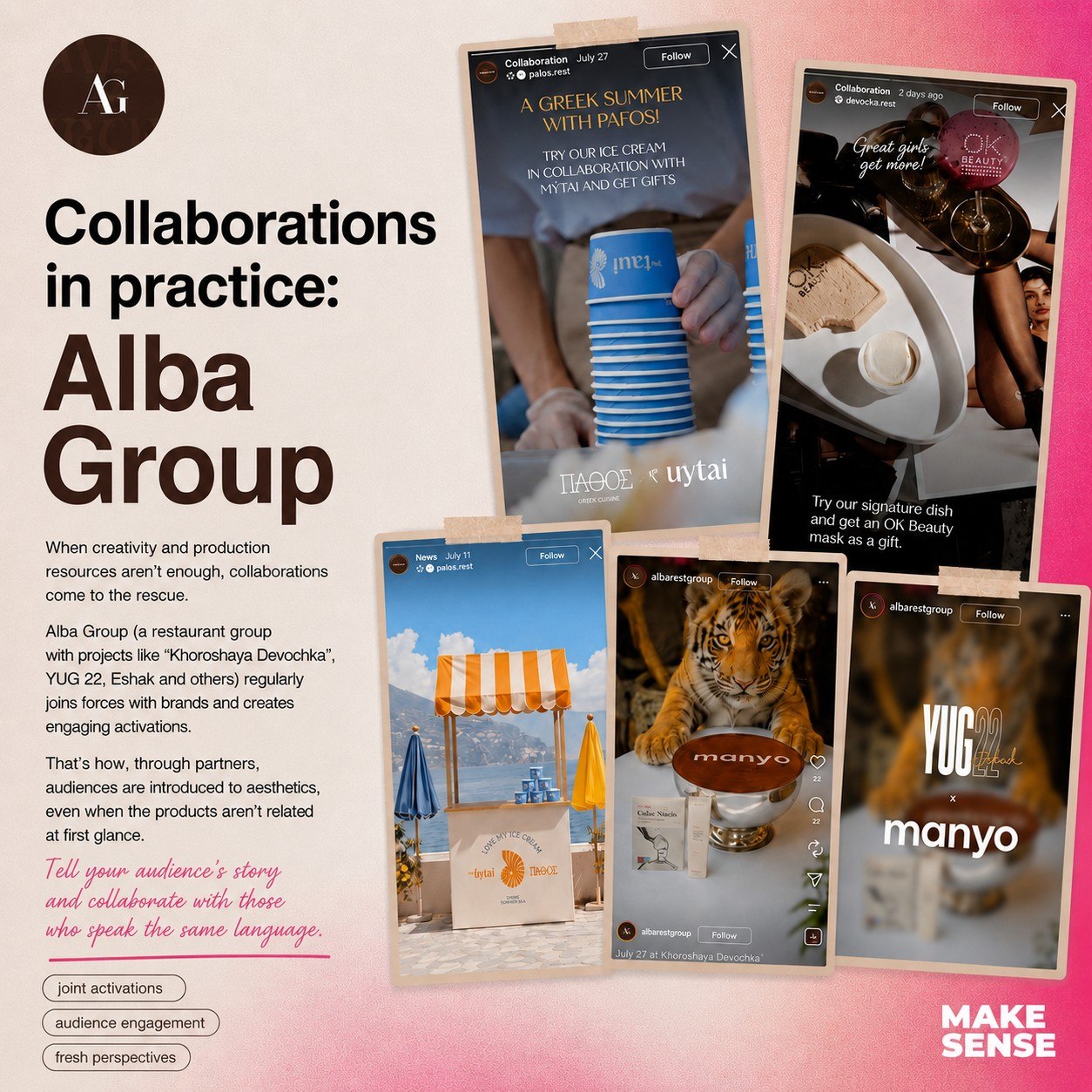
What do you do if you have neither money nor creativity? Here the initially bad news becomes good: many brands are in the same position, which means they are open to collaborations. And that’s a huge field of opportunity. Within this trend, I really like how Russian teams work, especially my ex-colleagues from Alba Group: they partner with local brands and create very interesting activations together.
The key principle is simple: both companies or products have a strong audience overlap and, likely, a stylistic overlap. Why not do something together, even if your products seem completely unrelated? What unites you is your audience — you just need to study it in detail and understand what they live and breathe.
What do you do if you have neither money nor creativity? Here the initially bad news becomes good: many brands are in the same position, which means they are open to collaborations. And that’s a huge field of opportunity. Within this trend, I really like how Russian teams work, especially my ex-colleagues from Alba Group: they partner with local brands and create very interesting activations together.
The key principle is simple: both companies or products have a strong audience overlap and, likely, a stylistic overlap. Why not do something together, even if your products seem completely unrelated? What unites you is your audience — you just need to study it in detail and understand what they live and breathe.
Beyond collaborations with companies from other niches, working with creators is starting to play an incredibly important role. In essence, we are now moving from influencer marketing and integrations in the most expensive YouTube show for 10 million to talent scouting.
In my view, teams that realize this in the coming years will be extremely effective and creative. If you have the resources, I’d recommend a strange experiment that I’m currently running myself: dedicate one person on the team whose sole job is to produce branded content and campaigns through collaborations with young, talented creators. I’m also personally drawn to this by the speed at which news hooks and reactive trends change: we barely have time to figure out how a certain format works, so why bother if you can find someone who is already on trend and create a joint project with them?
Make Sense in every message