It seems that today’s marketers have everything they need to capture their audience’s attention. We can analyze user behavior, predict reach, measure advertising performance, and create content in a matter of minutes. Yet the more tools we have at our disposal, the harder it becomes to answer a simple question: why do some advertising campaigns stay in people’s memories for years, while others are forgotten the moment they are seen?
Interestingly, we may find the answer in a text written more than two thousand years ago.
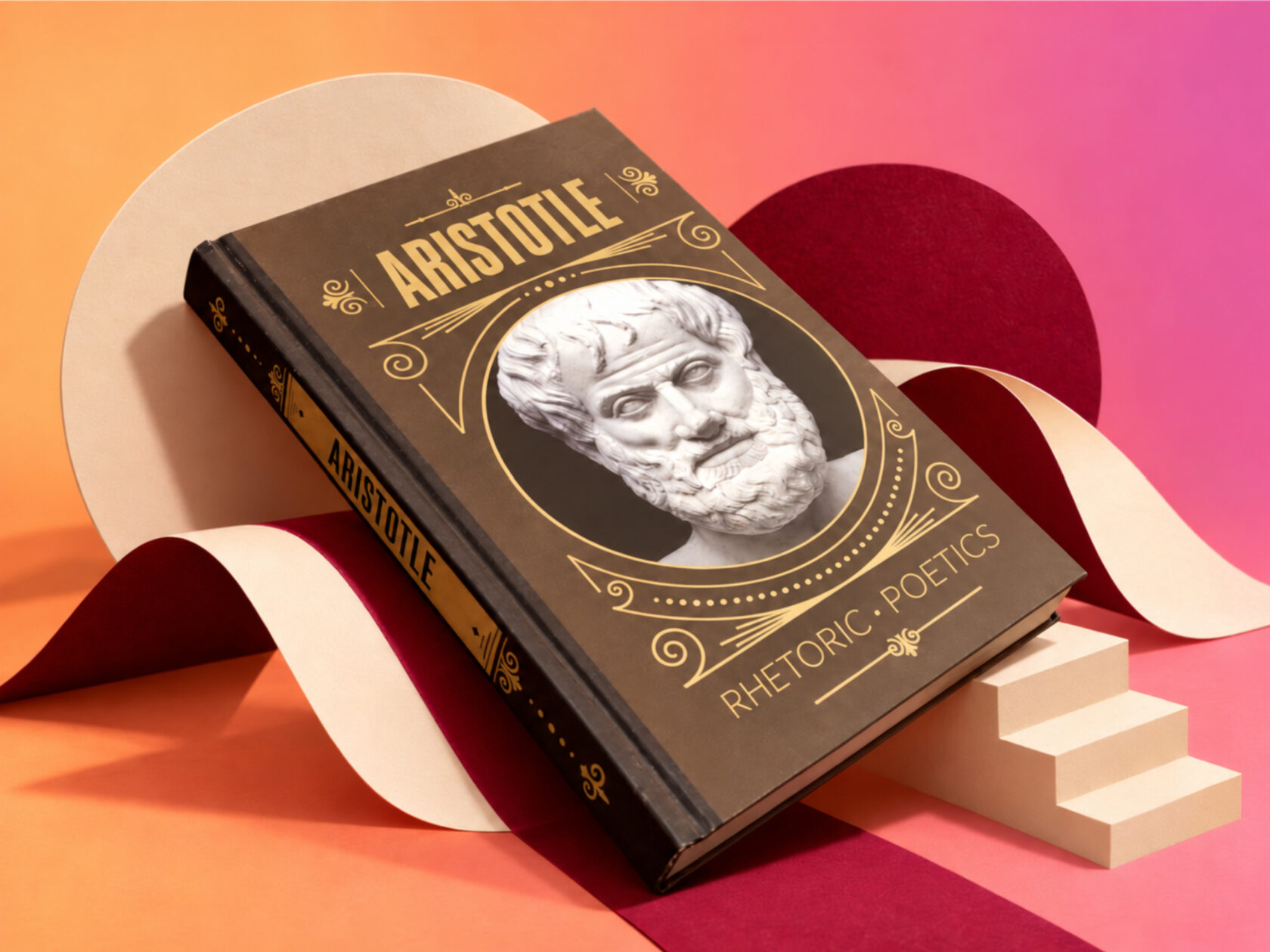
Aristotle’s Poetics is a treatise written around the 4th century BC that explores how literary works are structured and why some stories evoke powerful emotions while others do not. The philosopher primarily examined tragedy and epic poetry, but many of the principles he described remain relevant to modern communications.
Of course, Aristotle did not discuss brands, advertising strategies, or consumer behavior. However, he explained how stories can capture attention, evoke emotions, and leave a lasting impression. And in our view, this is more than just an interesting historical parallel. In an era when brands compete for every second of attention, the ability to tell a clear and emotionally compelling story is more important than ever.
Why Does Marketing Need Stories?
Today, brands produce enormous amounts of content. They launch advertising campaigns, manage social media accounts, collaborate with influencers, and strive to maintain a presence across multiple platforms.
However, more communication does not necessarily mean better communication.
The problem often lies in the absence of a unifying idea. A company may have striking visuals, a catchy slogan, and a detailed content plan, yet its audience may still struggle to understand what the brand is actually trying to say.
Aristotle considered mythos, or plot, to be the foundation of tragedy. It is the sequence of events and the relationships between them that determine the power of a work. What matters is not a collection of individually impressive scenes, but how they come together to form a coherent story.
A similar principle applies to marketing.
A strong campaign begins not with choosing a format or platform, but with understanding the story the brand wants to tell.
For example, a sportswear brand can endlessly talk about the quality of its materials and the technology behind its products. Or it can tell stories about self-doubt, fear of failure, and overcoming personal limitations.
In the second case, the product becomes part of a larger narrative in which people can recognize themselves.
“I love the idea that even thousands of years later, we can still find answers to modern questions in classical works. Reading Aristotle reminds us that a good story is always centered around people, their experiences, and emotions. This is just as important to us in communications. We want people not just to see an advertisement, but to recognize something of themselves in it,” emphasizes Alexandra Pertseva, Co-founder of Make Sense Communications Agency.
What Makes Communication Powerful?
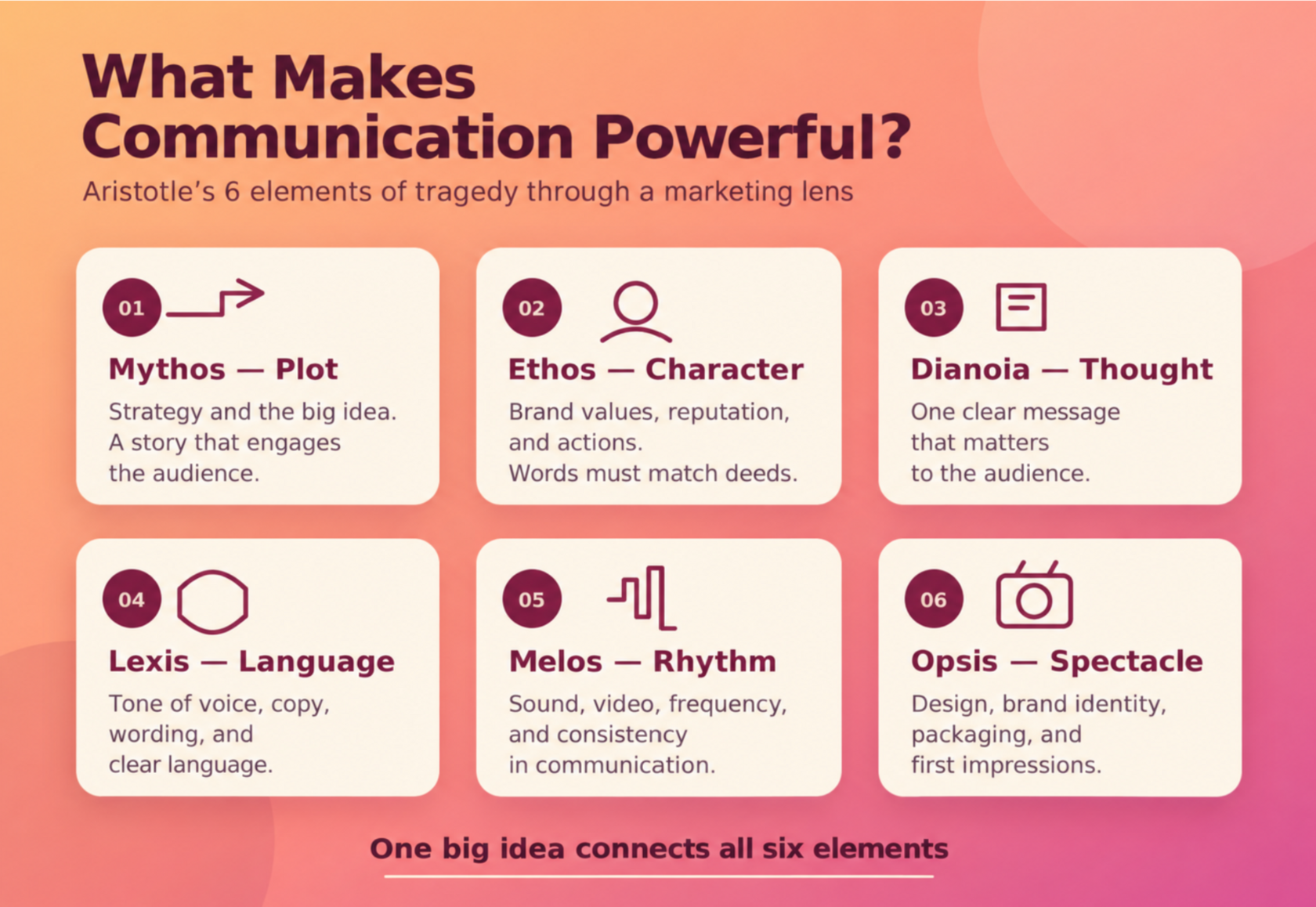
In Poetics, Aristotle identified six main elements of tragedy. Viewed through the lens of marketing, they offer an almost ready-made framework for developing a communication strategy.
Mythos — Plot.
In marketing, this corresponds to the strategy and the campaign’s big idea. The goal is not simply to produce content, but to understand what story the brand is telling, what its central conflict is, and why the audience should care about how it unfolds.
Ethos — Character.
This is how the audience perceives the brand: its values, reputation, public stance, and behavior in different situations. Today, simply declaring principles is no longer enough. A company’s actions must align with its words.
Dianoia — Thought.
This is the core message a brand wants to communicate.
Companies often try to say everything at once: highlight product benefits, showcase innovations, explain their values, and promote special offers. As a result, the central message gets lost.
Strong communication focuses on what truly matters to the audience.
Lexis — Language.
This is the brand’s language, tone of voice, copy, and choice of words.
What a company says matters, but so does how it says it. A clear and consistent communication style helps build trust.
Melos — Music and Rhythm.
In modern communications, this can be associated with sound, video, publishing frequency, and the sequence of interactions with the audience.
Sometimes a single powerful video is enough. In other cases, a longer campaign is needed to gradually develop and reveal an idea.
Opsis — Spectacle.
This is the visual dimension of communication: design, brand identity, packaging, and advertising materials.
Visuals are often the first point of contact between a person and a brand.
However, Aristotle did not place spectacle above plot. In his view, impressive form alone does not make a work powerful.
The same applies to marketing.
A company can produce an expensive commercial, hire a famous brand ambassador, and create stunning visuals. But without a clear underlying idea, that attention will not necessarily translate into genuine interest in the brand.
Why Do Some Campaigns Evoke Emotions While Others Do Not?
One of Aristotle’s most fascinating observations concerns the way stories affect people.
The philosopher described several narrative devices that can be compared to modern advertising storytelling.
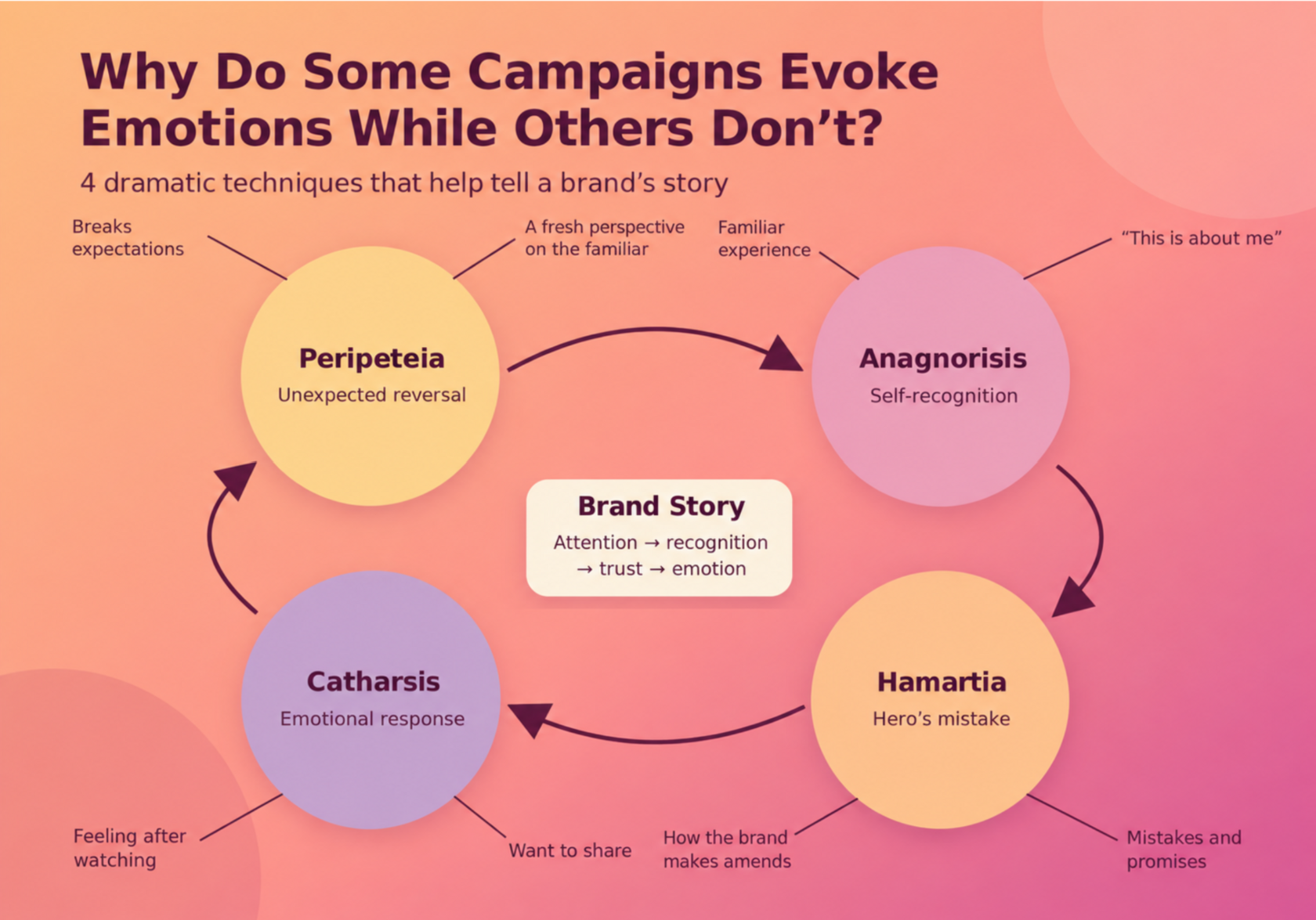
Peripeteia — Reversal.
An unexpected turn of events.
In advertising, this is the moment when a campaign challenges the audience’s expectations and invites people to look at a familiar situation from a different perspective.
Anagnorisis — Recognition.
In marketing, this is the moment when someone recognizes their own experiences, emotions, or problems in a story and thinks, “That’s exactly how I feel.”
Think of advertisements built around everyday relationships: conversations with parents, family traditions, awkward situations, or small personal victories.
These stories work not because they reveal something fundamentally new, but because they allow people to see themselves in the narrative.
Hamartia — A Hero’s Error.
An error or misjudgment that influences how events unfold.
In the context of branding, this can serve as a metaphor for poor decisions: making exaggerated promises, losing focus, or failing to listen to the audience.
Of course, a brand is not a tragic hero. But the analogy reminds us of something important: trust depends not only on avoiding mistakes, but also on how a company responds when it makes them.
Catharsis — Emotional Release.
The emotional experience and release associated with the action of a tragedy.
This concept cannot be transferred directly to marketing, but it encourages us to think about the feelings people are left with after watching an advertisement.
Does it make them smile? Reconsider a familiar situation? Want to share what they have seen? Or feel a stronger connection to the brand’s values?
Emotions do not guarantee commercial success, but they can make communication more personal and memorable.
One Big Idea Is Better Than Ten Small Ones
Another important principle of Poetics is the unity of action.
Contrary to popular belief, Aristotle did not formulate the famous rule of the three unities in the form that later became established in classical drama.
Instead, he placed particular emphasis on the unity of action: all events should be interconnected and form a coherent whole.
For marketing, this is practically a strategic principle in itself.
Today, a brand may run dozens of communication projects simultaneously. But if each exists in isolation, the audience will struggle to combine those individual messages into a consistent image of the company.
Unity does not mean that every advertisement must look the same or repeat the same slogan.
On the contrary, one big idea can take many different forms and find expression across a wide variety of formats. What matters is that they all follow a shared logic.
A good example is Nike’s “Just Do It” communication platform.
Behind those three short words lies more than a simple invitation to exercise. They express a broader idea: taking action despite doubts and personal limitations.
This allows the brand to create different campaigns, speak to different audiences, and tell new stories while maintaining a consistent underlying message.
It is precisely this kind of consistency that transforms individual posts, special projects, and advertising campaigns into a cohesive communication strategy.
Why Is This Especially Important Today?
Technology is constantly changing how content is created and distributed.
Artificial intelligence helps us write copy faster, develop visual concepts, and test ideas. Analytics tools allow us to measure results more accurately, while new platforms create additional opportunities to engage with audiences.
At the same time, however, the number of messages people encounter every day continues to grow.
In our view, this is exactly why the ability to create meaningful stories is becoming increasingly valuable.
As content production accelerates, it is important not to lose sight of why that content is being created in the first place.
A brand can use the most advanced technologies available, but without an understanding of its audience, a clear strategy, and a compelling central idea, its communication risks becoming just another post in the feed.
At Make Sense, we firmly believe that effective communication begins long before the first design mockup or advertising copy is created.
It begins with asking the right questions: What does the brand want to change? What value does it create? And why should any of this matter to people?
Make Sense in every message